

 |
 |
|
 |
|
 |
|
 |
|
 |


●
イーサネット・モバイル・バックホール設備は2010年に大きく急増する見込み
2010年10月14日、カリフォルニア、キャンベル-市場調査会社のInfonetics Researchは、モバイル・バックホール設備及びサービスの市場規模、市場シェア、市場予測に関する最新レポートを公表した。
アナリスト・ノート
「昨年、イーサネットをベースとしたモバイル・バックホール設備の売上が前年比36%上昇して48億ドルとなり、バックホール設備に対する総支出の80%を占めた。イーサネットに対する支出は、3GPPの市場で現在大きく増加しているHSPA/HSPA+ と3GPP2の使用者によるLTEの展開によって2010年に再び急増し、数年間は成長が続く見通しである。イーサネット市場には停滞が全く見られない。パケットタイミングやシンクロニゼーションなどのバックホール・ソリューションにおける改良が進められ、世界中の約100社のオペレータは現在、全トラフィックを流す目的で単一のIPイーサネット・バックホールを積極的に展開している。」とInfonetics Research主席アナリスト兼共同創立者Michael Howardは説明する。
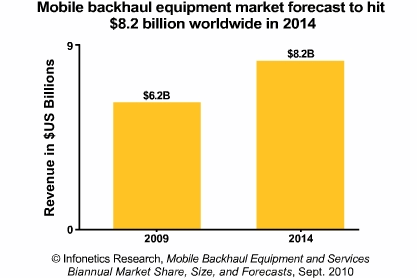
また、Infonetics のマイクロ波担当のディレクティング・アナリストであり本レポートの共同執筆者であるRichard Webbはこう付け加えている。「サービスプロバイダはパケット技術に移行するため、TDMマイクロ波機器の支出は今後毎年、大きく減少するが、全体のモバイル・バックホール設備市場は主にイーサネット設備の強みが元になり2014年までに82億ドルへ成長すると予測される。」
モバイル・バックホール設備市場ハイライト
- Ericssonは世界のモバイル・バックホール向けマイクロ波無線機器の収入でリードし、そのすぐ後をHuawei、 Nokia Siemens、NECが追っている。
- Alcatel-Lucentは、急速に成長するイーサネット・セルサイト・ルータとゲートウェイ部門における世界の売上で2010年上半期1位の座を占め、Tellabs、Cisco、Huaweiに勝った。
- 2010年から2014年の間に、サービスプロバイダはモバイル・バックホール設備に総額360億ドルの支出を行うと予測される。
- Infoneticsは、マイクロ波のイーサネット・モバイル・バックホール装置の売上が2010年には2009年比で367%増加すると予測している。
- イーサネット・セルサイト・ルータとゲートウェイの売上は2009年に2桁から3桁の割合で増加したが、少なくとも2014年までは前年比で増加が続くと見込まれる。
レポート概要
Infoneticsのモバイル・バックホールレポートは、世界と各地域の市場規模、ベンダーの市場シェア、2014年までの予測、詳細な分析、ベンダーとオペレータの活動、モバイルオペレータのバックホール戦略の追跡、技術ロードマップなどを提供する。本レポートは、技術と媒体(銅線、ファイバー、無線)を基準としたモバイル・バックホール設備、技術と媒体(1接続辺りの平均帯域を含む)を基準とした接続、媒体とRANの種類(2G、3G、LTE、WiMAX、混合)を基準とした設置済みのセルサイト、技術を基準としたサービス料金の追跡を行っている。
トラッキングしている技術は、PDHとPDHのATM、SONET/SDH、WDM、銅線とファイバーのイーサネット、DSL、PON、同軸ケーブル、マイクロ波、TDM、イーサネット、WiMAX、衛星である。また、IPモバイル・バックホール設備の分類(疑似回線が設定可能か否か)も提供している。
トラッキングしている企業は、Actelis、ADTRAN、ADVA、Alcatel-Lucent、Alvarion、ANDA、BridgeWave、Cambridge、Celtro、 Ceragon、Ciena、Cisco、DragonWave、ECI、Ericsson、IPITEK、Hatteras、Huawei、Juniper、MRV、NEC、Nokia Siemens、Overture、RAD Data、Tellabs、ZTE、その他である。
(原文)
Ethernet mobile backhaul equipment on track for big spike in 2010
CAMPBELL, California, October 14, 2010-Market research firm Infonetics Research released its updated Mobile Backhaul Equipment and Services market size, market share, and forecast report.
ANALYST NOTES
"Last year Ethernet-based mobile backhaul equipment sales jumped 36% year-over-year, to $4.8 billion, representing 80% of total backhaul spend. We expect Ethernet spending to spike again in 2010 and growth to continue for many years, fueled by the ongoing HSPA/HSPA+ onslaught across the 3GPP world and early LTE deployments led by 3GPP2 players. We see no letup in the Ethernet market: improvements to backhaul solutions, such as packet timing and synchronization, have been made, and about 100 operators around the world are now actively deploying a single IP-Ethernet backhaul to carry all traffic," explains Michael Howard, principal analyst and co-founder of Infonetics Research.
Richard Webb, directing analyst for micro wave at Infonetics and co-author of the report, adds: "Even with TDM microwave spending declining significantly every year from here on out as service providers move to packet technology, we expect the overall mobile backhaul equipment market to grow to $8.2 billion by 2014 based mainly on the strength of Ethernet equipment."
MOBILE BACKHAUL EQUIPMENT MARKET HIGHLIGHTS
- Ericsson continues to lead in worldwide mobile backhaul microwave radio revenue market share, following closely by Huawei, Nokia Siemens, and NEC
- Alcatel-Lucent holds the #1 spot in the first half of 2010 for worldwide revenue in the fast-growing Ethernet cell site routers and gateways segment, ahead of Tellabs, Cisco, and Huawei
- Between 2010 and 2014, service providers are expected to spend a cumulative $36 billion worldwide on mobile backhaul equipment
- Infonetics expects revenue from microwave Ethernet mobile backhaul equipment to jump 367% in 2010 over 2009
- Ethernet cell site routers and gateways posted double- and triple-digit percent revenue increases in 2009 and are expected to continue growing year-over-year at least through 2014
REPORT SYNOPSIS
Infonetics' Mobile Backhaul report provides worldwide and regional market size, vendor market share, forecasts through 2014, in-depth analysis, vendor and operator activity, a mobile operator backhaul strategies tracker, and technology roadmaps. The report tracks mobile backhaul equipment by technology and medium (copper, fiber, air); connections by technology and medium (including average bandwidth per connection); installed cell sites by medium and type of RAN (2G, 3G, LTE, WiMAX, mixed), and service charges by technology.
Technologies tracked include PDH and ATM over PDH, SONET/SDH and WDM, Ethernet copper and fiber, DSL, PON, coax cable, microwave, TDM, Ethernet, WiMAX, and satellite. A breakdown for IP mobile backhaul equipment (pseudowire-enabled vs. not pseudowire-enabled) is also provided.
Companies tracked include Actelis, ADTRAN, ADVA, Alcatel-Lucent, Alvarion, ANDA, BridgeWave, Cambridge, Celtro, Ceragon, Ciena, Cisco, DragonWave, ECI, Ericsson, IPITEK, Hatteras, Huawei, Juniper, MRV, NEC, Nokia Siemens, Overture, RAD Data, Tellabs, ZTE, and others.
